


Freight Under Scrutiny: Where are savings headed?
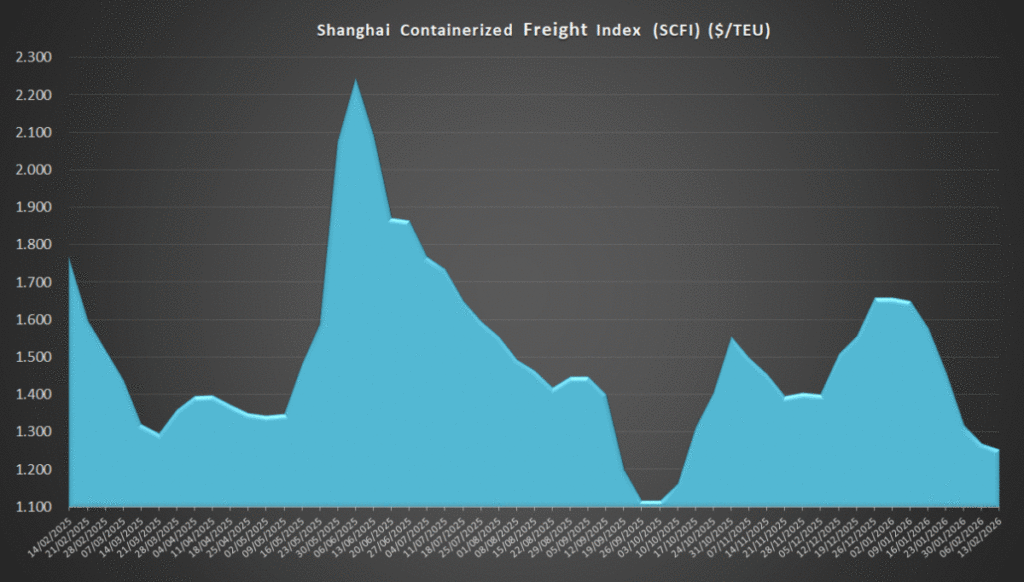
Looking at the Shanghai Containerized Freight Index (SCFI) for the past year, the graph is revealing, showing a peak of tension that reached almost $2,250/TEU in mid-2025. This surge was no accident: it was the result of a perfect storm where localized congestion at key ports and the massive diversion of routes around the Cape of Good Hope absorbed capacity all at once. However, after that stress, the market has entered a sustained downward trend to the current $1,250, a figure that provides some relief to the bottom line, but which requires careful analysis.
The primary driver of this decline is the sluggishness of global consumption. Demand has yet to recover, which has reduced pressure on cargo holds. Added to this is a structural factor: oversupply. Shipping companies are receiving a wave of new, high-capacity vessels ordered after the pandemic-induced boom. There are simply more ships than cargo. Furthermore, the gradual return to the Suez Canal is injecting even more effective capacity into the system by reducing transit times and increasing fleet turnover.
Despite this “low price” scenario, we shouldn’t be overly optimistic. Shippers haven’t gained absolute negotiating power; shipping lines still control the supply. What we do have is a much more favorable negotiation environment for renewing contracts on more competitive terms than a year ago. But beware: the shipping industry is already reacting to protect its margins.
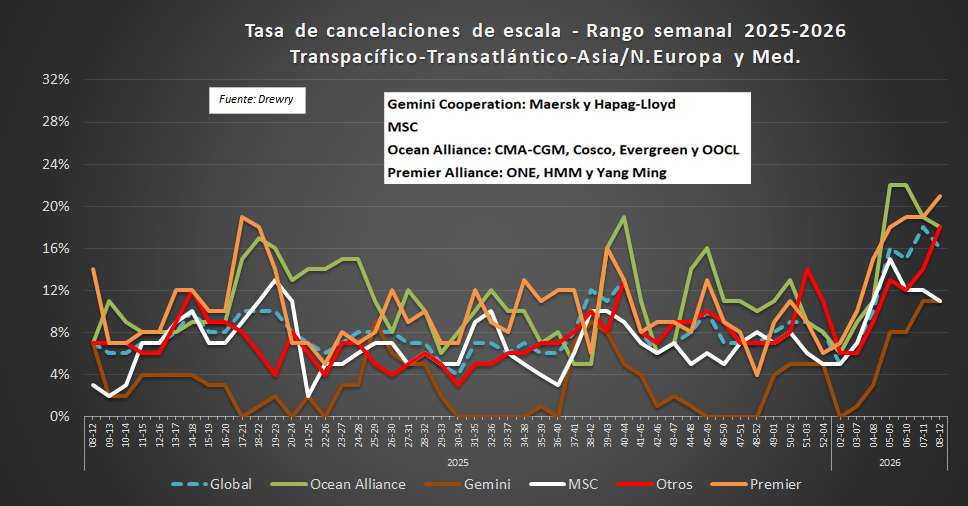
As the rate of port call cancellations shows, alliances are implementing drastic cuts to prevent a price collapse. Especially in early 2026, we see cancellation peaks exceeding 20% in the Ocean Alliance and Premier Alliance. This is the shipping lines’ defense mechanism: if there are too many ships and too little cargo, they simply stop operating port calls to artificially maintain a shortage of space.
💡 The Shipper’s Decision: Flexibility
Despite this favorable cost scenario, shippers must be alert to the potential reaction of shipping lines. With so much excess capacity, it is very likely that we will see more cancellations of port calls as they try to reduce supply and support prices.
Practical Advice: Take advantage of the current situation to negotiate, but prioritize flexibility. In a market that is still finding its bottom, now is not the time to commit to long-term contracts. Barring any geopolitical surprises, we believe that this period of calm is here to stay for a while.
Share this article
Come and visit us at Logistic & Industrial Build Madrid
Keep up to date
The container celebrates its 70th anniversary as a key element of the global transport revolution
Seventy years after the voyage that sparked the modern era of containerisation, this unit of load forms the basis of intermodal transport networks and moves
The ‘cold millionaires’: the most unexpected side effect of the new weight-loss drugs
The pharmaceutical cold chain has evolved from a niche sector to become a strategic component of the industry. Major operators are investing billions in an
Logistics take-up exceeded one million square metres in Spain in the first half of 2026
This represents an 80 per cent increase on the same period last year, according to the latest analysis by Cushman & Wakefield. The Spanish logistics
Montepino’s logistics portfolio is valued at 1,557 million euros
In 2025, Montepino posted a consolidated profit of 84 million euros, with rental income of 62 million euros, up 30 per cent year-on-year. Meanwhile, the